

An applied leadership case study in program operations and implementation
Effective programs depend on more than written policies and procedures. Staff need clear workflows, defined responsibilities, practical documentation guidance, and the tools to carry out their work consistently.
During a cross-department operational improvement initiative in a community healthcare setting, I applied an operational improvement approach and selected Program Operations Blueprints developed through Empower Health Solutions.
The challenge
The initiative focused on improving coordination across nonmedical services, including intake, eligibility, scheduling, referrals, and case management. The goal was to establish clearer processes and help staff understand what to do, when to do it, and who was responsible.
The approach
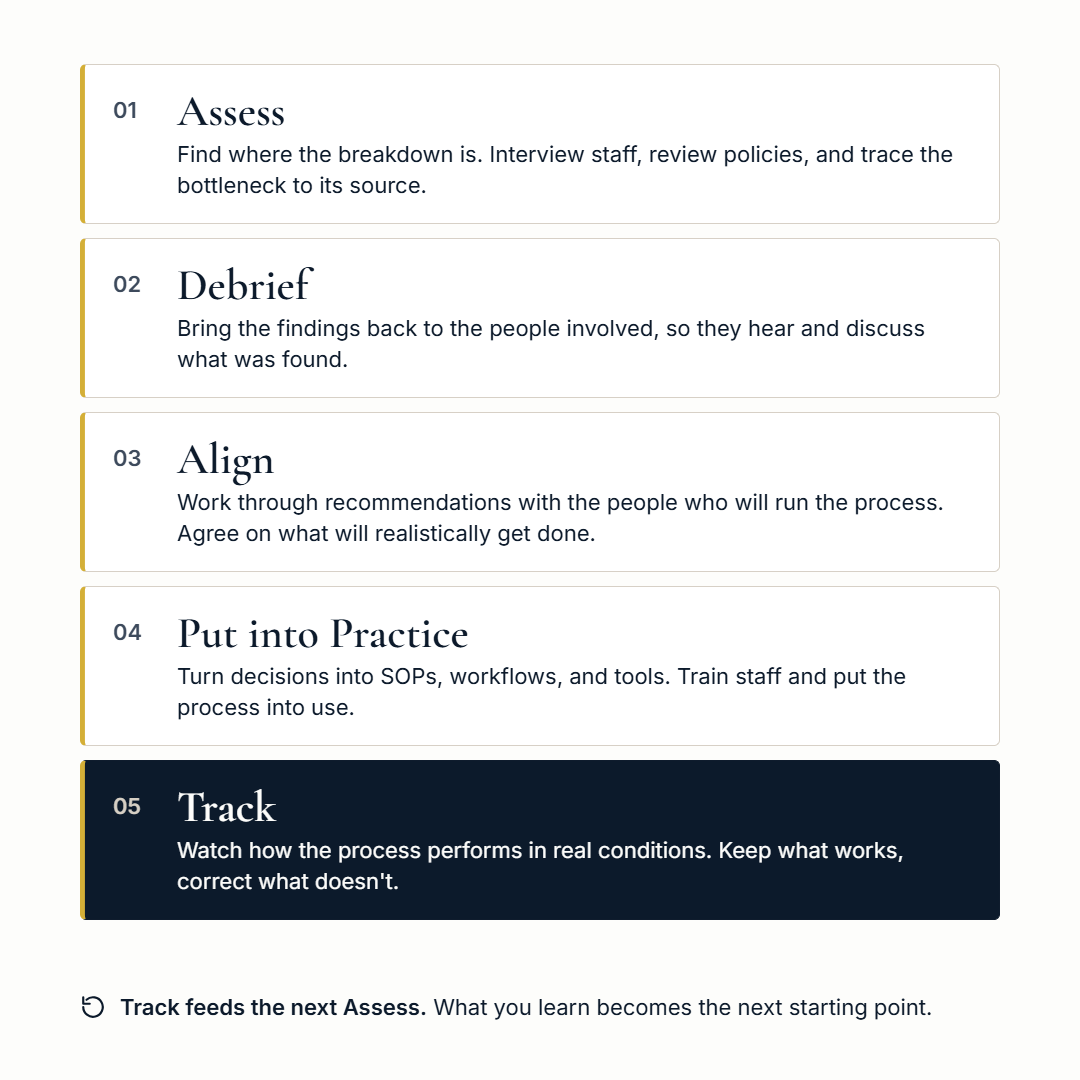
The work contributed to the refinement of my five-phase Program to Practice framework:
Four Program Operations Blueprints supported the initiative: Workflows & Process Documentation, Eligibility & Enrollment, Client & Service Documentation, and Staffing, Roles & Training.
Putting improvements into practice
The initiative included frontline feedback, updated operational guidance, staff resources, documentation training, patient communication, and cross-department implementation coordination.
An appointments-based access process for designated nonmedical services launched in early November 2026. Monitoring is ongoing, and longer-term results are still under review.
Lessons learned
This experience reinforced three important principles:
Frontline feedback should inform decisions before workflows are finalized.
Staff need practical tools and training, not just policy announcements.
Successful implementation requires monitoring and adjustment after launch.
How this informs my consulting practice
Through Empower Health Solutions, I help organizations assess operational challenges, improve workflows, develop procedures, strengthen documentation practices, and support staff through implementation.
The goal is to turn program requirements into systems that work in practice.
This case study describes professional experience gained in an internal healthcare leadership role. It does not represent a client engagement conducted by Empower Health Solutions.